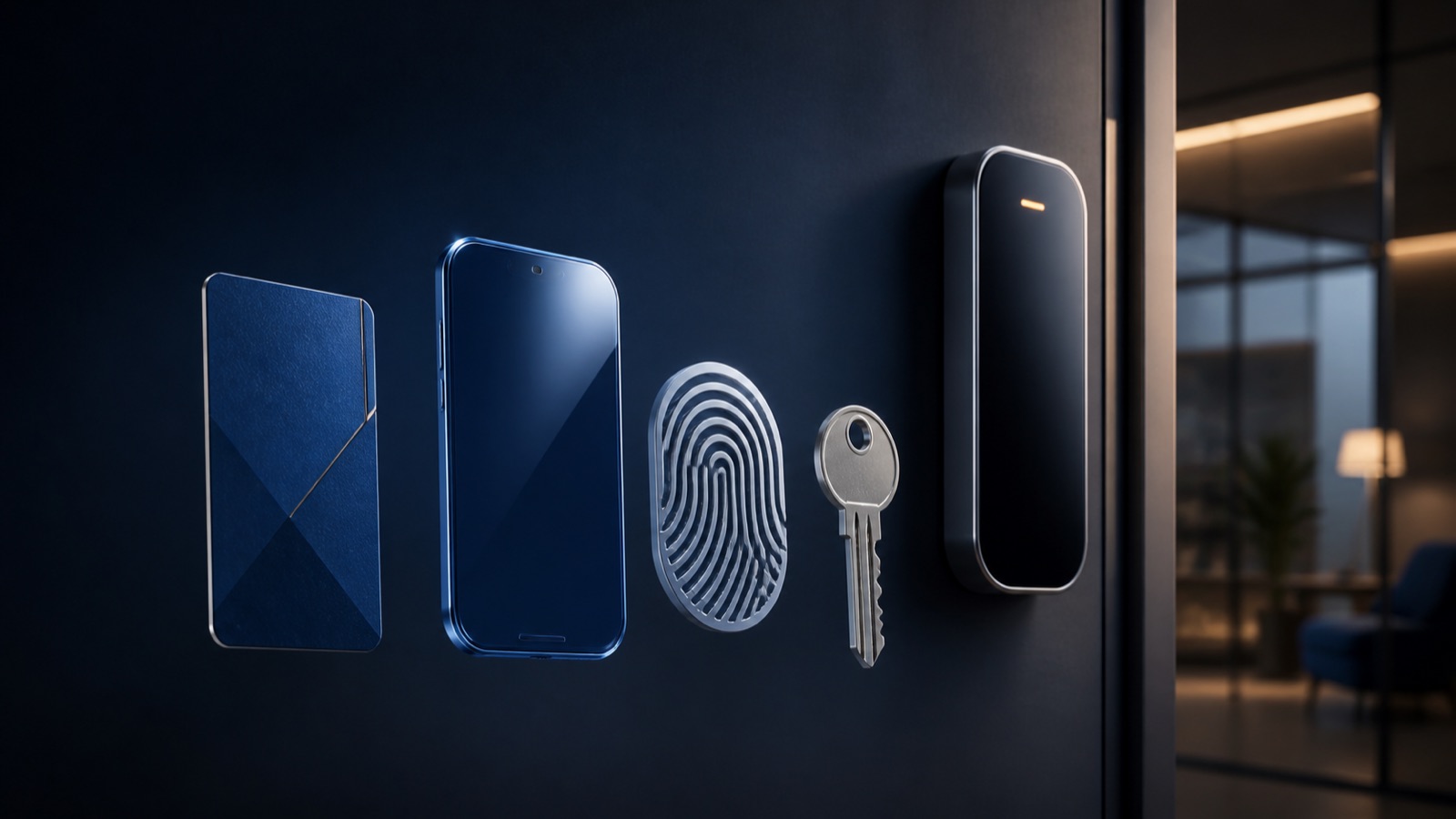
TL;DR
- Cards are familiar and replaceable; mobile credentials reduce physical tokens but depend on phones and administration.
- Biometrics can improve identity assurance in suitable contexts but require careful privacy, fallback and operational planning.
- Choose after defining users, doors, visitor flows, revocation, outages and support—not by novelty.
Quick answer: Compare office access cards, mobile credentials and biometrics by privacy, lifecycle, usability, failure behaviour, administration and cost.
The reader is only one part of access control. Credential choice affects enrolment, lost-device handling, privacy, visitor experience and daily support.
Start with Technobyte’s access control planning and confirm legal, building and life-safety requirements with qualified parties.
When are access cards appropriate?
Cards and fobs are widely understood, quick to issue and easy to revoke. They create physical inventory and can be shared unless paired with policy or additional verification. Plan printing, spares, returns and lost-card response.
What changes with mobile credentials?
Mobile access can reduce separate tokens and support remote issuance, but it relies on compatible phones, apps, connectivity assumptions and a process for changed or lost devices. Provide a route for visitors and people without supported devices.
Where do biometrics fit?
Biometrics connect access to a physical characteristic, but templates are sensitive personal data and cannot be reissued like a card. Assess necessity, consent or other lawful basis, storage, retention, false rejection, accessibility and a non-biometric fallback with specialist advice.
Use a decision matrix for each door
- Required assurance and consequence of unauthorised entry.
- User count, visitors, contractors and accessibility.
- Enrolment, revocation and support ownership.
- Power, network and controller failure behaviour.
- Privacy, records, integrations and total lifecycle cost.
Frequently asked questions
Are mobile credentials more secure than cards?
Security depends on the complete system, device controls, issuance, revocation and fallback. Mobile credentials can offer benefits but are not automatically safer in every deployment.
Can biometric access control work without storing fingerprints?
Systems may store mathematical templates rather than images, but these can still be sensitive biometric data. Verify the architecture, legal basis, retention and protections.
Should offices keep a mechanical key fallback?
Many doors require an appropriate override or emergency method, but the correct arrangement depends on door hardware, life safety and building requirements. Use qualified specialists.